Hegemony and gender in disney
Why do you believe the media and specifically films are effective in communicating hegemonic ideals (the accepted norm?)
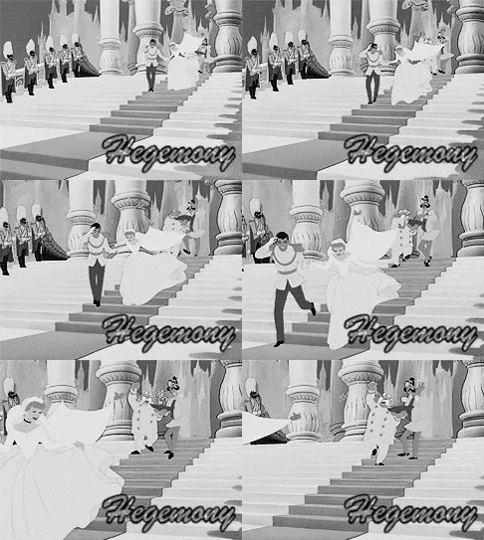
I watched various videos of different genres using hegemony but chose to talk about Disney with fantasy, adventure, and childish genres because this company extremely highlights hegemony and the lack of change there is within its films, even if characters slightly evolve as the years pass. There's mainly use of continuity and sticks to its traditional gender roles which are further analyzed in this video and the analysis I have done below on Frozen.

Hegemony in media is considered a perceived process by which certain values and ways of thought promulgated through the mass media become dominant in society. It is seen in particular as reinforcing the capitalist system.The key theoretical concept that animates much of the contemporary study of the ideology of media is hegemony. Drawn from the work of Antonio Gramsci (1971), an Italian Marxist who wrote in the 1920s and 1930s, the notion of hegemony connects questions of culture, power, and ideology. In short, Gramsci argued that ruling groups can maintain their power through force, consent, or a combination of the two. Gramsci noted, however, that power can be wielded at the level of culture or ideology, not just through the use of force.
Hegemony, Gender Stereotypes, and Disney:
The Hegemonic concept was applied to the female roles of Frozen through oppositional ideology. Hegemony, and the Feminist Criticism written by Bonnie J. Dow in 1990, studied the hegemonic process on television. It explained how characters in films may be depicted as overcoming past issues. In reality, those same issues still occur, but are masked and presented contrastively. Disney has maintained its existing gender messages. Todd Gitlin, (1979) who also focused on hegemony in television, explained the simple process of hiring writers who will describe the “standardized, static characters than the characters who develop” . Frozen fell under the standard criteria of men obtaining the most dominance in Disney films. The writers developed the characters of Anna and Elsa acquiring male characteristics and male dependency rather than constructing them to have their own independent personalities and roles. It reflects the inflexibility of social change and lack of transformation from past Disney films. This could be due to “the dominance of a certain way of life” that shapes the “culture, values, and ideology” factors in society. In this context, dominance refers to strong male portrayals in past films, including Snow White, that are repeated and applied to Frozen. Although the dominance of men overshadows women in Disney films, people are satisfied with the idea that there is an increasing number of female leads that have evolved since past Disney films. However, Dow goes on to say that “those who create the programming actually have made only cosmetic changes in the representation of the disputed group,”. There has been a minimum amount of progress of differences between men and women's traits in the oldest and newest Disney films. Anna in Frozen depended on Prince Hans and Kristoff for happiness just as Snow White depended on her Prince to live “happily ever after.” Hegemony is applied to the film by twisting the plot. Although Anna essentially chooses her sister at the end of the film, she gets the man as well. There is this ongoing trend that women in Disney films are required to obtain a relationship to be fulfilled.


Comments
Post a Comment